Control gaps & capacity3 min read
Too little. Too much. The problem is in between.
One compressor starts and another soon unloads. Sometimes the station simply lacks the right capacity range. Learn to spot the gap between combinations.

What are control gaps in a compressor station?
01Think of capacity as steps and ranges
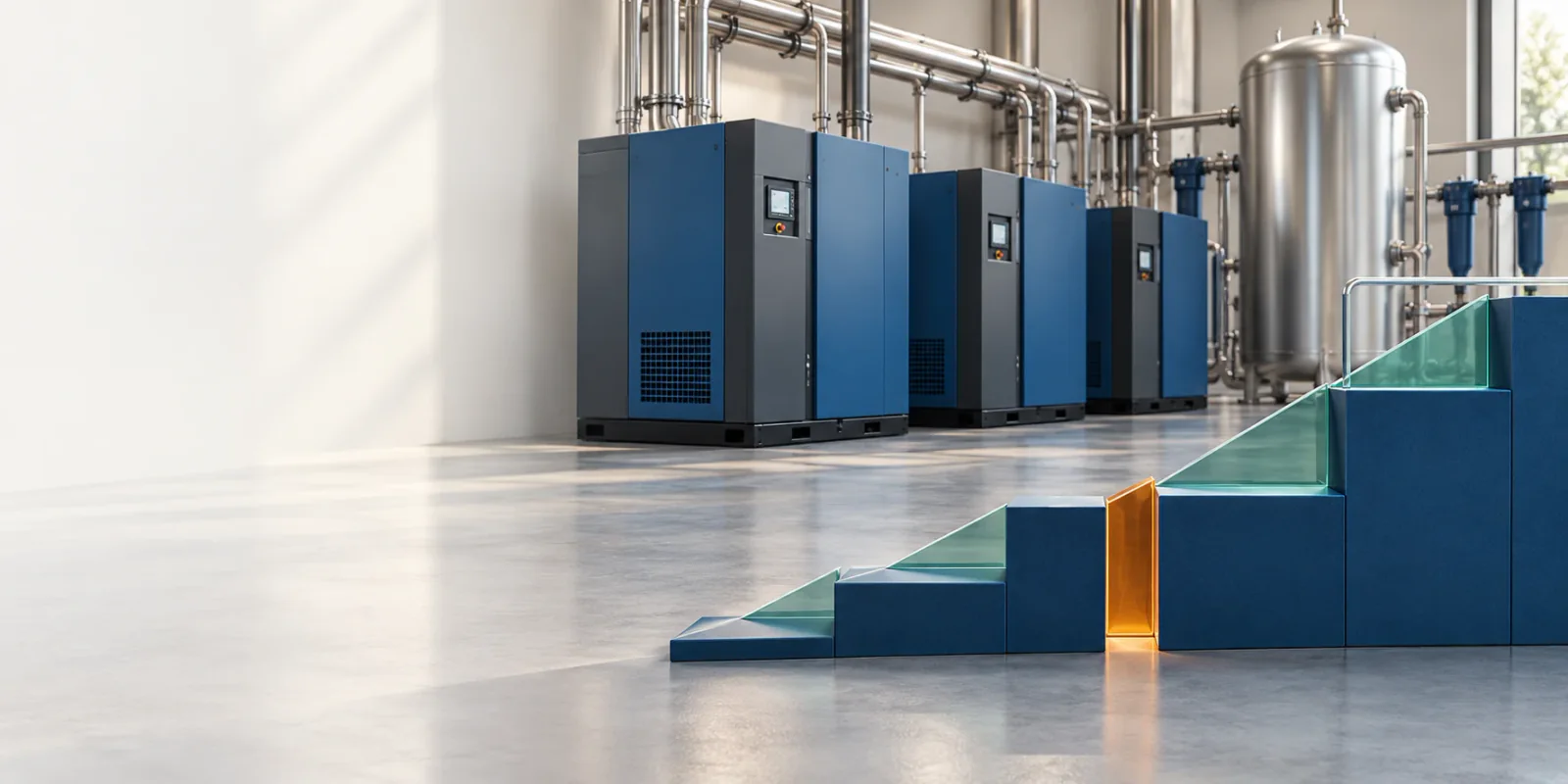
A fixed-speed compressor provides a capacity step. A variable-speed machine covers a range between minimum and maximum flow. Several machines create additional combinations. Useful operating ranges should connect or overlap appropriately for stable operation.
02A simple example
An illustrative variable-speed machine delivers 2 to 6 m³/min. Adding a fixed-capacity machine supplying 8 m³/min creates a combined range of 10 to 14 m³/min. Even if the fixed machine can provide 8 m³/min on its own, not every flow between 6 and 10 m³/min is continuously covered. Demand within an uncovered range requires transitions between states. These are simplified example values.

03What does storage change?
An air receiver can buffer temporary differences between generation and demand. It does not change the compressors' continuously available capacities. The practical effect of a transition also depends on network volume, permitted pressure band, demand dynamics and switching constraints.
04How do you investigate gaps?
List the usable flow ranges of the machines and compare them with the demand profile. Rated and actual performance may differ. The interactive calculator reveals mathematical gaps; measured data shows how often the station operates in those ranges.
05Which measures can help?
Assess alternative combinations, priorities and operating ranges. Some stations require a different machine mix. Consider pressure stability, starts, idle energy and reserve capacity. The calculator supports an initial assessment; station design also requires operating data.
From understanding to action
What is happening in your station?
Let us look at demand, machine operation and the next useful measurement together.